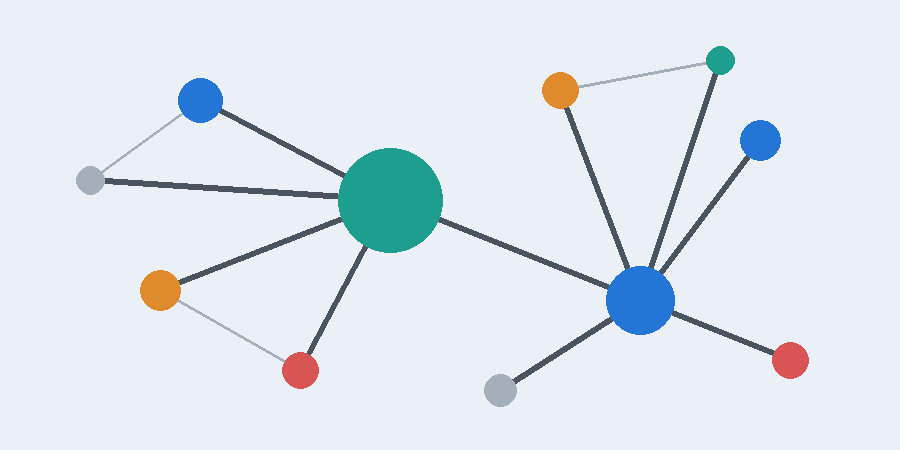
Legend says Frank McNamara finished a Manhattan dinner in 1950, reached for a wallet that was not there, and decided embarrassment should be a business model. Diners Club, the cardboard card born from that evening, made money only if restaurants and diners showed up together, in the right proportions, at the same time. Getting that dance right is now the central problem of the world’s most valuable companies. Platform economics, the study of network effects and two-sided markets, explains who dances, who pays the band, and why so many ballrooms stand empty.
Dinner Without a Wallet: Two-Sided Markets Before Software
Company lore, as Diners Club polished it for decades, begins with an empty pocket. One evening in 1949, the businessman Frank McNamara finished dinner at Major’s Cabin Grill, a Manhattan steakhouse in the shadow of the Empire State Building, and discovered he had left his wallet in another suit. His wife reportedly drove in to settle the bill. In February 1950 he returned with his lawyer Ralph Schneider, ate again, and paid with a small cardboard rectangle: the first Diners Club card. Publicity men canonized the evening as the First Supper. Matty Simmons, the publicist who spread the tale, conceded late in life that the forgotten wallet was probably invented, which in a way makes the legend more instructive. Diners Club grasped from its earliest weeks that it was selling a story about trust between strangers, because trust between strangers was the entire product.
Strip away the mythology and the machine underneath looks startlingly modern. On one side stood cardholders, a few hundred at the start, mostly Manhattan salesmen recruited through the founders’ address books, who paid little or nothing at first and later a modest annual fee reported at a few dollars. On the other stood restaurants, roughly a couple dozen New York establishments at launch, which agreed to surrender about 7 percent of every card-paid check. Neither side had any use for the arrangement alone. A card no restaurant honored was cardboard. A participating restaurant with no cardholders had merely offered a discount to nobody. Every new member made the network slightly more valuable to every restaurant, and every new restaurant made the card slightly more valuable to every diner. Economists would eventually call these cross-side externalities. McNamara simply called on restaurateurs and promised them expense-account customers who spent freely because settlement was painless, then called on salesmen and promised them a wallet that never ran empty.
Skewed pricing was the real invention. Diners Club charged the merchant side heavily and the consumer side barely at all, having grasped that restaurants would pay for access to affluent diners far more readily than diners would pay for access to restaurants they could already walk into. Reported figures suggest the club grew from its founding handful to tens of thousands of members within about a year, with charge volume said to have reached the low millions of dollars. Its 7 percent toll on that flow, not any kitchen or dining room, was the business.
Matchmakers Before Modems
None of this logic waited for 1950, let alone for software. Medieval fairs in Champagne prospered because the counts who ran them solved a coordination problem: cloth merchants from Flanders would make the journey only if Italian buyers came too, and vice versa, so the fairs guaranteed safe passage, enforced contracts, and collected fees on the commerce they convened. A village market square is a two-sided platform built of stone. So is a stock exchange, which recruits listed companies on one side and traders on the other and knows that liquidity begets liquidity. Penny papers of the 1830s discovered the model in print, selling copies below cost to assemble a mass readership and then selling that readership to advertisers, who footed the true bill. Twentieth-century shopping malls ran the same play in concrete, courting anchor department stores with famously cheap rent because their gravity pulled shoppers past the smaller tenants who paid full freight.
Vail’s Wager on a Single Connected System
Alongside these matchmakers ran a purer strain of the same economics. Theodore Vail, who led AT&T in the early twentieth century, argued in the company’s annual reports around 1908 that a telephone’s worth lay entirely in its connections, and that subscribers gathered on one exchange were worth far more than the same number scattered across incompatible ones. His slogan of one system offering universal service was a monopolist’s pitch, but the underlying observation proved sound and durable. Decades later the fax machine became the textbook case: the first unit ever sold could reach nobody and was therefore close to worthless, while each additional machine enriched every machine already installed. Note the difference in shape, though. Fax owners benefit from more fax owners, a direct, same-side network effect. Diners Club members gained little from other members; they gained from restaurants, and restaurants from them. Two-sided markets run on that crosswise pull, which is why they pose the chicken-and-egg problem in its purest form: each side rationally waits for the other to arrive first.
Pipelines Sell Output, Platforms Tax Flow
Set the older examples beside the newer vocabulary and a clean distinction emerges. A pipeline business creates value along a chain it controls: it buys inputs, transforms them, and sells the result at a markup, the way a steel mill, a film studio, or a traditional retailer does. Ford’s River Rouge complex, taking in iron ore at one end and driving finished cars out the other, was the pipeline ideal made physical. A platform manufactures comparatively little of its own product. It orchestrates value creation between outsiders who could not easily find, trust, or pay one another, and it taxes the resulting flow. Diners Club seared no steaks and poured no wine. It produced the introduction and the settlement, and took its seven points off the top.
After 1950, and then decisively after the internet, the economics never changed; the friction did. Champagne’s fairs convened a few times a year because moving merchants was slow. Diners Club needed embossed cards, paper chits, and weeks of float because moving information was slow. Software collapsed the cost of connection toward zero, made matching instantaneous, and extended a single marketplace’s reach to anyone holding a phone. Cross-side externalities, skewed pricing, the cold-start agony of an empty room: all of it was centuries old. Code merely released the logic from geography and let it compound at planetary scale, which is where both the fortunes and the trouble begin.
Five Flavors of Gravity: Cataloging Network Effects
Economists file all of this under a single label, network effects, and the label hides at least five distinct forces, each with its own physics. Some pull users toward one another directly. Some operate across a divide, matching one side of a market to the other. Some run through data, some through geography, and some, past a threshold, push users away. Sorting them matters, because investors who treat the label as one switch routinely misprice the companies underneath it.
Same-Side Pull, Priced by the Head
Direct effects are the original species: each additional user makes the product more valuable to every existing user on the same side. Telephones are the canonical case. One phone is a paperweight, two phones are a conversation, and a million phones are a society. Messaging apps inherit that logic wholesale, which is why they resist competition so stubbornly; your messenger is only as good as the share of your contacts already on it. Consider the starkest price tag ever hung on a direct effect: in 2014 Facebook paid roughly 19 billion dollars for WhatsApp, a company reported at the time to have on the order of half a billion users and revenue that rounded to a curiosity. That works out to roughly 40 dollars per user. Facebook was not buying a business in any conventional sense; it was buying a graph, priced by the head, and betting that the connections would eventually dwarf the income statement.
Two Rooms, One Party
Indirect, or cross-side, effects run between distinct groups. Windows became valuable to users because developers wrote for it, and developers wrote for it because the users were there; that loop, once spinning, protected Microsoft’s position for decades. Apple replayed the pattern with iOS and the App Store, consoles replay it with game studios, and ride-hailing replays it with riders and drivers. Notice what is absent: a rider gains nothing from other riders as such. More riders can even hurt, through surge prices and longer waits. All of the pull comes from the other room. Cross-side effects therefore live and die on balance. A platform flush with sellers and short of buyers is a warehouse; the reverse is a queue.
Data Loops and Their Plateaus
Data network effects are the fashionable cousin. Every query teaches a search engine which results deserve to rank, every skipped song sharpens a recommender, and the improved product attracts more usage, which teaches it further. Google’s long dominance in search owes something real to this loop. Honesty demands a caveat that pitch decks omit: data effects usually plateau. On the order of the ten millionth driving hour, a mapping service learns far less than it did during the first million, and past some point a rival with a competent algorithm and a modest corpus can close most of the gap. Data advantages are genuine, decaying, and routinely oversold.
Liquidity Is Local
Plenty of celebrated networks are not one network at all. They are federations of small ones. Uber’s liquidity is city-by-city; a dense driver pool in Chicago does nothing for a rider standing in the rain in Austin. OpenTable had to win restaurants neighborhood-by-neighborhood, because a diner deciding where to eat on a given evening compares a handful of nearby rooms, not a national inventory. Push the logic across borders and it sharpens: a platform can dominate Jakarta and be irrelevant in Lagos, which is roughly what the map of ride-hailing actually shows, with regional champions strong at home and thin everywhere else. Local networks must be conquered one at a time, and can be lost the same way, which is why a global brand protects less than its founders assume.
Gravity in Reverse
Every one of these forces has a negative twin. Congestion turns density into delay when demand outruns capacity. Spam follows audiences the way flies follow picnics, and each fraudulent listing or phishing message taxes everyone’s trust. Usenet veterans still speak of the eternal September of 1993, when a large online service connected its subscribers to the network and the newcomers arrived faster than the culture could absorb them; growth itself broke the thing that made growth attractive. Ad load works the same way in slow motion, since each additional ad lifts revenue while degrading the feed, until users quietly drift off. Beyond some density, in other words, the next user subtracts value, and managing that boundary is half of platform governance.
Sarnoff, Metcalfe, Reed, and a Sober Correction
Engineers have long tried to compress all this into laws. David Sarnoff, presiding over broadcast radio, held that a network’s value grows in proportion to its audience, a straight line. Robert Metcalfe, who co-invented Ethernet, argued that value tracks the number of possible connections, which grows roughly as the square of the user count. David Reed went further, observing that a network permitting group formation contains a number of possible subgroups that doubles with every member, implying exponential value. Skeptics, notably Andrew Odlyzko and his collaborators, countered that most possible connections are worthless: you will never call the overwhelming majority of people reachable by your phone. Rank everyone you could connect with by importance and the value falls off quickly down the list, the same Zipf-style pattern seen in word frequencies and city sizes, which suggests total value closer to n log n, well above linear yet far below Metcalfe’s promise. The empirical record is thinner than the theorizing, but studies fitting the revenues of Facebook and Tencent against their user counts have reported Metcalfe-like curves, so the square law retains defenders with data in hand.
Whichever exponent one prefers, the honest reading is that network effects are a spectrum, not a badge. Their strength is an empirical question: how much the marginal user raises value for everyone else, how quickly that increment decays, and how easily users can maintain a rival in their pocket. Those measurements, far more than any law, decide which platforms compound and which merely grow.
| Network effect | Mechanism | Habitat |
|---|---|---|
| Direct | Each user makes the product better for every other user | Telephones, messaging, social graphs |
| Indirect (cross-side) | One side attracts the other side | OS and developers, riders and drivers |
| Data | Usage improves the product via learning | Search, recommendations, maps |
| Social and local | Value clusters by city or community | Ride-hailing, reservations, classifieds |
| Negative | Crowding erodes value per user | Spam, congestion, ad-stuffed feeds |
Cold Starts and Kindling: Manufacturing Critical Mass
Every network business begins in the one state its own logic says should not exist: empty. A marketplace with no sellers offers buyers nothing to browse, so buyers stay away, which gives sellers no reason to list, which keeps the shelves bare. Below some threshold of participation the arithmetic runs backward: each departure makes the platform slightly worse for everyone who remains, churn outruns signups, and the whole thing quietly unravels. Above that threshold the same feedback loop flips sign. Each arrival makes the service marginally more useful to the next prospect, adoption accelerates, and growth starts paying for itself. Economists describe this as a system with multiple equilibria separated by an unstable tipping point; founders experience it as a ridge line in the dark. Tip past it and momentum takes over. Fall short, even narrowly, and gravity does the rest. Beneath the mythology, nearly every famous platform origin story recounts how someone manufactured enough density to cross that ridge before the money ran out.
Tools First, Networks Later
One elegant answer hides the network inside a product that needs no network at all. OpenTable spent its early years selling restaurants an electronic reservation book: software that replaced the pencil-and-paper ledger at the host stand and justified its cost on operational grounds alone. Only after a reported few thousand restaurants were running the system did the consumer booking site become compelling, because by then a diner searching for a table actually found one. Instagram ran the same play on the consumer side. At launch it was, for most users, a filters app, a way to make phone photos look good in one tap, valuable to a person with zero followers. The feed, the likes, and the following graph grew up around a utility people had already adopted for private reasons. Come for the tool, stay for the network, as the playbook is now taught.
Beachheads, Not Continents
Density is a ratio, not a headcount, which is why shrewd cold starts shrink the denominator. Facebook did not launch to the world; it launched to Harvard, where a reported majority of undergraduates joined within weeks, then rolled outward campus by campus, arriving everywhere with proof that everyone you knew would be there. Amazon, planning a store for everything, opened in the mid-nineties selling only books, a category with millions of titles, clean metadata, and easy shipping, and dominated it before adding a second shelf. Uber began in San Francisco with black cars: a premium niche in a single dense city, where a modest fleet of drivers could deliver pickup times short enough to feel like magic. In each case the beachhead was chosen so that critical mass was reachable with the resources at hand. Saturate a small pond completely, then replicate; the alternative is being shallow everywhere.
Paying the Scarce Side to Show Up
When one side of the market is the bottleneck, platforms simply buy its presence. Uber entered new cities offering drivers hourly guarantees, paying them to circle empty streets so that the first riders to open the app would see cars nearby; the subsidy converted a dismal early experience into a plausible one. DoorDash used signup and per-delivery bonuses to stock new markets with couriers before order volume could support them. YouTube, having grasped that watch time follows creators, began sharing advertising revenue through its partner program in roughly 2007 and later spent a reported nine-figure sum commissioning original channels. Such outlays look ruinous per transaction and sensible on a systems view: the platform is purchasing the missing half of its own flywheel.
Kindling Laid by Hand
Some of the most storied tactics were pure handcraft. Airbnb’s founders, as they have recounted, flew to New York, borrowed a camera, and photographed hosts’ apartments themselves after noticing that dim phone snapshots were strangling bookings; listings with professional photos reportedly earned several times more. Reddit’s creators seeded their empty site with posts from invented usernames, manufacturing the appearance of a lively community until a real one materialized to match it. PayPal, needing eBay sellers to accept the service, reportedly deployed a bot that bought goods on the auction site and insisted on paying with PayPal, so sellers kept encountering customers who demanded it. Each move was unscalable, faintly embarrassing, and decisive. Early founders are not building the machine; they are being the machine until it can run on its own.
Borrowed Graphs
Another shortcut grows on somebody else’s network. PayPal did not construct a payments graph from nothing; it colonized eBay, where buyers and sellers already needed to move money and where the auction house’s in-house payment product was losing the fight. Zoom spread through calendar invites: every scheduled meeting became a distribution event, and guests could join with one click and no account, so each host quietly recruited a roomful of future hosts. Instagram made cross-posting to Facebook and Twitter effortless, letting a tiny app siphon attention from graphs many times its size. Piggybacking has a shelf life, since hosts eventually notice, as PayPal’s own later history with eBay can attest. As ignition, though, it is unmatched: the coldest part of the cold start gets borrowed rather than solved.
Liquidity or Nothing
Failure usually arrives wide and thin: dozens of cities at once, every category on day one, a user base large in aggregate and useless in every particular. A rider waiting twenty minutes, a host with no bookings, a forum thread with no replies never experiences total registered users; each experiences the local match rate, and each churns on that basis alone. Seasoned marketplace operators therefore insist that early on, liquidity is the only metric that matters: the probability that a listing sells, a request gets filled, a question gets answered, within a tolerable wait. Vanity numbers can climb while liquidity stalls, and such platforms are already dead. Survivors pick a market small enough to saturate, subsidize and handcraft their way to matches that clear, and only then, with the flywheel turning, permit themselves geography.
Charging the Other Guy: Price Architecture on Two Floors
Every merchant who has grumbled about card fees has brushed against one of the deeper results in modern industrial economics without knowing it. Jean-Charles Rochet and Jean Tirole, working in Toulouse in the early 2000s, posed a question that sounds almost too simple to publish: when one firm serves two groups at once, does it matter how the total price is split between them? Textbook logic says no. If a tax lands on the buyer rather than the seller, the market shuffles the burden around until incidence settles where elasticities dictate, and the split written on paper is irrelevant. Rochet and Tirole showed that on a platform this neutrality breaks. Merchants cannot quietly hand a card fee back to a specific cardholder, and a restaurant cannot bill a booking service’s charge to the one diner it delivered. Because the two sides cannot renegotiate the split between themselves, the structure of prices, not just their sum, determines who shows up on each floor. Their striking corollary followed: the profit-maximizing platform will often price one side below cost, sometimes below zero, and recover everything, plus margin, from the other.
Look around and the pattern is everywhere once named. Google and Facebook charge the people who search and scroll exactly nothing; advertisers fund the entire apparatus because those users are the product being aggregated. OpenTable seats diners for free while restaurants pay a fee reported at roughly a dollar for every cover the service delivers to the table. Card networks push past zero altogether: cardholders collect rewards worth on the order of one or two percent of spending, a negative price for the act of paying, while merchants remit interchange fees that in the United States have hovered around two percent of each transaction. Game consoles ship at or near hardware cost, and in famous cases below it (Sony was reported at the time to lose money on every early PlayStation 3 sold), while studios pay the console maker a royalty on the order of several dollars for each game that reaches a player.
Stated in words, the recipe is short. Subsidize the side that is price-sensitive and that the other side most values having around; charge the side that is willing to pay for access to the first. Diners scatter at the first hint of a booking fee, and restaurants prize a full dining room, so diners ride free and restaurants carry the freight. Cardholders can always pay cash; merchants can rarely refuse a card their customers expect to use. Free, in this world, is not charity and not a loss leader waiting for its bait-and-switch moment. It is equilibrium, the price that a rational profit maximizer chooses for one floor precisely because of what it unlocks on the other.
Zero Reads as a Crime Until You Check Both Ledgers
Antitrust doctrine grew up on one-sided markets, and a zero price short-circuits its instruments. Predatory pricing analysis asks whether a firm priced below cost with a plan to recoup later through monopoly rents. On a platform, below-cost pricing on one side is not a temporary war measure; it is the permanent, profit-maximizing arrangement, with recoupment happening simultaneously on the opposite floor. Accusations that a free consumer product must be predation misread the architecture. The confusion reached the United States Supreme Court in 2018 in Ohio v. American Express, decided by a reported five to four margin. Amex forbade merchants from steering customers toward cheaper cards, and the states argued this propped up merchant fees. The majority held that credit card transactions occur in a single two-sided relevant market, so plaintiffs had to show harm net of both sides, counting cardholder rewards against merchant charges. Critics of the ruling say it turned a subtle economic insight into a demanding legal hurdle; defenders reply that ignoring the second ledger would condemn the subsidy structure itself. Either way, the case made Rochet and Tirole’s blackboard argument a matter of controlling precedent.
Scissors in Brussels and Sydney
Regulators have tried instead to re-split the burden by decree. Australia’s Reserve Bank moved first, cutting credit card interchange roughly in half beginning around 2003. The European Union followed with caps reported at roughly 0.3 percent of transaction value on credit cards and 0.2 percent on debit, and the United States capped debit interchange for large banks after 2010. The results read like a seminar on incidence. Merchant fees fell where the caps bound, but rewards programs thinned and cardholder annual fees crept upward, and economists still argue over how much of the merchant savings reached retail prices. Squeezing one floor of a two-sided structure does not make the platform’s revenue requirement disappear; it migrates, in proportions no regulator fully controls.
Thirty Percent, and the Gravity Acting on It
Where a platform charges its money side per transaction, the fee goes by a blunter name: the take rate, the platform’s tax on commerce it enables. Apple set its app store commission at a reported 30 percent in 2008, a number lifted almost directly from console royalty conventions, and Google matched it. Marketplaces settle lower, with Amazon’s referral fees commonly cited in the mid-teens as a share of each sale. Payment processors sit lower still, in the low single digits, because moving money is closer to a commodity than distributing software. None of these numbers is a law of nature. Developer revolt, the Epic litigation, and regulatory scrutiny pushed Apple and then Google to a 15 percent tier for smaller developers after 2020, and Europe’s Digital Markets Act has pried open alternative billing routes. Each take rate reflects a bargaining position: how much value the platform adds, and how credibly its subjects can threaten to sell somewhere else. Competition and regulation both act on that position like gravity, slow, cumulative, and pointed in one direction.
| Platform | Subsidy side | Money side |
|---|---|---|
| Credit card networks | Cardholders (rewards, a negative price) | Merchants (interchange fees) |
| Search and social media | Users (free forever) | Advertisers |
| Game consoles | Players (hardware near or below cost) | Studios (per-game royalties) |
| Restaurant reservations | Diners (free, plus points) | Restaurants (per seated cover) |
| App stores | Users (free downloads) | Developers (15 to 30 percent) |
Ninety Percent Markets and the Exits Nobody Guards
Concentration in platform markets is overdetermined. Network effects hand the biggest player a product that improves with every arrival. Scale economies spread the fixed cost of code and data centers across users who cost almost nothing to serve at the margin. Switching costs then lock in whoever arrived first: documents in one format, followers on one graph, seller ratings earned on one marketplace and worthless anywhere else. Each force alone tilts a market. Stacked together, they generate the statistics regulators recite from memory. Windows sat above 90 percent of desktop operating systems for roughly two decades. Google has hovered around 90 percent of global search queries for most of its corporate life. Facebook’s family of apps reports billions of users, an audience no broadcaster or newspaper chain ever came close to assembling.
Economists are careful to say winner-take-most rather than winner-take-all, and the hedge earns its keep. Tipping is a tendency, not a law. The same models that explain why one network should swallow a market say little about why the swallowing so often fails, which makes the failures the more instructive half of the record.
Headstones Bearing Famous Logos
Friendster signed up millions before most people had heard the phrase social network, then buckled under slow servers and its own hesitation. MySpace replaced it and was reported at the time, in 2006, to be the most visited website in the United States, ahead of Google. News Corp had paid roughly 580 million dollars for it; within a few years Facebook swept past, and MySpace eventually changed hands for a reported 35 million. Yahoo organized the early web as a portal and watched Google reorganize it with a better ranking algorithm and a blank page.
Incumbency and money bought no immunity either. Google Plus launched with every distribution weapon Google owned, including notification badges wired into search, YouTube, and Gmail, and still shut its consumer service in 2019 amid vanishing usage. Microsoft poured billions into Windows Phone, including a Nokia acquisition largely written off at a reported 7.6 billion dollars, and never pried developers away from iOS and Android; the third ecosystem died of emptiness. Clubhouse, valued at roughly 4 billion dollars near its 2021 peak, watched its live audio rooms thin out within a year as lockdowns ended and rivals cloned the feature in weeks.
Escape Hatches Left Unlocked
Markets stay contestable when the exits stay open, and several rarely close. Multihoming is the widest. Drivers run Uber and Lyft on the same phone and take whichever ride pays better that minute. Merchants list identical inventory on Amazon, eBay, Etsy, and their own storefronts. Most smartphone owners carry four or five messaging apps without thinking about it. Wherever participation on one platform costs nothing on another, the incumbent’s network is rented rather than owned, and a challenger does not need users to leave, only to add one more icon.
Differentiation opens a second exit. TikTok never attacked Facebook’s social graph; it declared the graph irrelevant. Its feed ranks on inferred interest rather than friendship, so a newcomer with zero friends gets a compelling product within minutes. Nearly two decades of accumulated friend connections, the deepest moat in social software, defended against replicas and meant nothing against a rival playing a different game.
Geography and demography carve dominance into smaller pieces. Ride hailing and food delivery run on local network effects: matching drivers to riders in Jakarta says nothing about Sao Paulo, which is why regional champions such as Grab, Gojek, and Didi held their home markets against Uber’s capital. Generations, meanwhile, insist on their own platforms. Teenagers left Facebook for Instagram, then Snapchat, then TikTok, less because the old network failed than because their parents had arrived on it.
Envelopment is the exit that incumbents themselves use as an entrance. WeChat began as chat and swallowed payments, shopping, ride booking, and eventually government services into a single app, so that messaging leadership in China became leverage over a wide slice of daily commerce. Microsoft ran the same play defensively, bundling Teams into Office subscriptions at no extra charge just as Slack was converting the corporate world. Slack complained to European regulators in 2020 and sold itself to Salesforce for a reported 27.7 billion dollars; the EU case dragged on until Microsoft agreed to unbundle. Bundling, the oldest trick in software, remains the fastest way to inherit a network someone else built.
Moats Facing the Wrong Direction
Policy has fixated on switching costs, and the favored remedy is data portability: the right, under European law and now the Digital Markets Act, to take your data and go. Portability helps less than its advocates hoped, because the binding constraint was never your own archive. Exporting your photos takes an afternoon. Exporting your friends, your followers, and the ambient expectation that everyone you know can be reached at one address is impossible, which is why interoperability mandates, forcing rival networks to talk to each other, aim at the harder problem and draw the fiercer resistance.
Add the record up and it argues for a sober middle reading. Network effects are a genuine moat, wide enough that no pure clone has ever displaced a healthy incumbent: look-alike search engines and Facebook replicas litter the graveyard beside the fallen giants. But the moat defends a category, not a company’s future, and categories shift. Search did not beat the portal at portaling, the feed did not beat search at searching, and the interest graph did not beat the friend graph at friendship; each successor changed the question. Ninety percent shares measure command of the last paradigm at the moment of measurement, and nearly every number in this section was once cited as proof that the game was over. The moat is real. It simply faces the past, while the invaders keep arriving from the future.
| Fallen platform | Cause of death, in one line |
|---|---|
| MySpace | Outbuilt by a cleaner graph and faster product cadence |
| Google Plus | Launched wide and thin, no community ever reached density |
| Windows Phone | App cold start never broken, developers never came |
| Friendster | Performance collapse while rivals crossed critical mass |
| Clubhouse | Novelty spike without a retention loop underneath |
Referees Who Own the Stadium: Governing the Platform
Markets do not run on price alone. They run on rules: who may sell, what happens when a package never arrives, which complaints get heard, and who pays when trust breaks down. States built that machinery over centuries with courts, licenses, and inspectors. Platforms built it in years, privately, and made it a feature. Every large marketplace is, underneath the interface, a regulatory state with a terms-of-service constitution, an algorithmic police force, and no elections.
eBay wrote the founding document. In the mid-1990s the company invited buyers to mail checks and money orders to strangers identified only by a screen name, an arrangement that should have collapsed under fraud within months. It survived because of the feedback score, a running public tally of ratings and comments that turned a seller’s future income into collateral for present honesty. Reputation had always disciplined merchants in villages, where gossip travels fast; eBay’s insight was that a database could carry gossip at continental scale. Sellers with thousands of positive ratings held an asset worth protecting, and buyers could price that asset at a glance. Economists later measured the premium good reputations earned, but the practical proof came first: millions of strangers wired money to millions of other strangers, and mostly received what they paid for.
Trust as a Manufactured Good
Airbnb ran the same experiment with higher stakes, since a bad transaction meant a stranger sleeping in your home rather than a defective figurine in the mail. Early catastrophes made the risk vivid: in 2011 a San Francisco host returned to find her apartment ransacked, an episode that dominated coverage of the young company for weeks. Airbnb’s answer was layered rather than singular. Two-sided reviews came first, then verified identification, then a host guarantee reported at the time at roughly a million dollars, extended later into liability insurance. None of these layers was exotic; vetting and insurance are old industries. Bundling them into the transaction itself, so that trust arrives packaged with the booking, was the product.
Uber’s version displaced a public institution. The taxi medallion was a quality promise enforced by scarcity and licensing: a driver who misbehaved put a valuable permit at risk. Uber substituted a two-way rating, collected after every ride and aggregated into a score that could end a driver’s access to the app. Regulation by license became regulation by continuous audience. Riders gained an accountability the medallion rarely delivered in practice, and drivers gained a boss made of arithmetic, with deactivation thresholds standing in for due process.
Rulebooks Are Products Too
Once a platform holds this power, every governance choice doubles as a business decision. The take rate is a tax rate, set by a sovereign who also profits from it. The ranking algorithm decides which sellers exist commercially and which sink to page nine. Ban policy is a criminal code; the appeals process, where one exists, is the judiciary. Data policy determines whether a merchant may know its own customers or must rent them back, transaction by transaction. Nothing here is neutral plumbing. A marketplace that boosts sponsored listings is taxing attention; one that hides buyer contact details is defending its toll booth.
That toll booth sits under quiet siege. Disintermediation, the polite word for cutting out the matchmaker, is the tax evasion of the platform economy. Handymen found through an app hand over a business card and offer the next job cheaper, off the books. Tutors move recurring lessons to direct payment after the first match. Platforms answer with services that make leaving expensive: escrow and payment protection, insurance that covers only on-platform bookings, scheduling, invoicing, and dispute resolution that no solo operator can replicate. One lesson has been learned expensively across dozens of categories: a matchmaker who only matches gets paid once. Durable platforms sell the infrastructure of the relationship, not the introduction.
Thirty Percent and Its Discontents
Private regulators eventually meet public ones. Apple’s App Store commission, roughly 30 percent on most paid transactions, became the emblematic fight. Epic Games engineered a confrontation in 2020, slipping its own payment system into Fortnite and suing when Apple expelled the game. American courts largely sided with Apple on the antitrust claims while ordering steering concessions, requiring the company to let developers point users toward outside payment options. Europe went further by statute. Its Digital Markets Act designated the largest platforms as gatekeepers and attached obligations: alternative app stores and sideloading on iOS, interoperability requirements for messaging services, bans on self-preferencing, limits on combining user data across products.
Amazon embodies the deepest version of the conflict, because it referees a marketplace in which it also plays. The company sells its own products beside third-party merchants, and regulators on both sides of the Atlantic examined whether it mined those merchants’ sales data to decide which items to clone under private labels. Amazon reportedly settled the European case in 2022 with commitments on data use and on fair treatment in the algorithmic slot that decides which seller wins a given purchase. Whatever the settlement papers say, the structural fact remains: the stadium owner suits up for one of the teams, and the other teams have nowhere comparable to play.
None of this diminishes what private governance built. Feedback scores, guarantees, and ratings organized markets that formal institutions never managed to reach, and did so quickly, cheaply, and across borders no court can cross. Yet the platform century’s central tension is exactly this: its best referees are also owners of the stadium, with every incentive to call the game their way. Whether that tension resolves is the next act’s question, already visible in interoperability mandates, open protocols, and AI agents that negotiate across platforms rather than living inside any single one. Those experiments will test whether network effects can be shared rather than owned, and the rules, for once, are up for grabs.